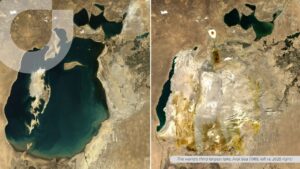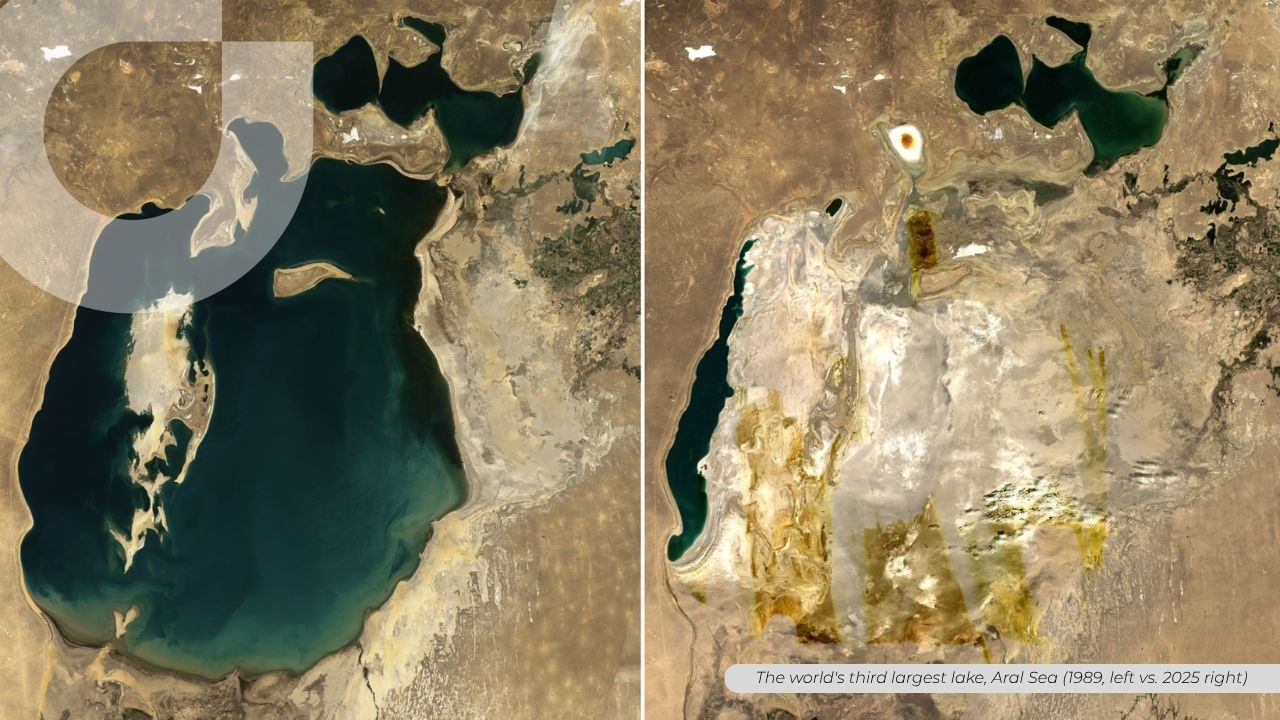
Recently, UN researchers did something unusually useful: they chose a metaphor that forces a balance-sheet conversation instead of another round of crisis vocabulary. “Water bankruptcy,” as framed in the new UNU-INWEH flagship report, is not a dramatic synonym for scarcity. It is a diagnosis that says many basins are no longer oscillating between stress and recovery; they are living beyond their hydrological means, drawing down natural “savings” (aquifers, glaciers, wetlands, soils) and degrading the productive assets that make
water available and usable in the first place.
The numbers attached to the metaphor are stark. Reuters’ summary of the report highlights that roughly three-quarters of the global population live in countries classified as water insecure or critically water insecure, and about 4 billion people face severe water scarcity for at least one month each year. Other media reports capture the deeper point: the report argues we have crossed a threshold in enough “critical systems” that global water risk has changed in kind, not just scale, because trade, migration, and supply chains transmit local hydrological failure into macroeconomic and geopolitical instability.
If we accept the bankruptcy framing, it changes what “success” looks like. In financial bankruptcy, you do not fix insolvency with optimistic projections; you fix it with hard accounting, enforceable limits, and a restructuring of obligations that protects the vulnerable while restoring solvency. The UNU-INWEH report calls for a shift from repeatedly reacting to emergencies to “bankruptcy management”: transparent water accounting, protection of water-related natural capital, and equity-oriented transition choices.
So far, so familiar: a daunting physical reality implies an equally daunting investment agenda. And indeed, the investment gaps are enormous. The Joint MDB Water Security Financing Report 2024 (led by the World Bank with nine other MDBs) pointed to an estimated annual spending gap of roughly $131–$141 billion (midpoint ~$138 billion) for water supply and sanitation to meet SDG 6 targets, with much larger multipliers required in Sub-Saharan Africa and in fragile contexts. Climate volatility only widens the gap because it raises both capex needs and the cost of failure.
But here is where I part company with the dominant narrative in boardrooms and at conferences: the binding constraint in water is increasingly not global capital availability. It is execution risk: our collective inability to convert “available money” into operating, maintained, and socially legitimate water outcomes at speed and at scale.
Consider what the same MDB report quietly admits in one of its most consequential lines. Despite huge needs and funding gaps, countries do not spend all the funding allocated to water. A World Bank study cited in the report finds that during 2009–2020, average budget execution in the water sector was 72%. Execution was materially higher in other sectors: human development at 99%, transport at 91%, and agriculture at 89%. That is not a marginal efficiency issue; it is a systemic delivery constraint.
This is the paradox at the heart of water finance today:
- We can truthfully say the sector is underinvested.
- We can also truthfully say that when funds are budgeted or committed, a large share fails to translate into completed assets and sustained services.
In other words, we have a funding gap, but we also have a delivery gap. And in a world of “water bankruptcy,” the delivery gap becomes even more dangerous, because hydrological decline does not wait for our procurement cycles, institutional reforms, or fragmented project pipelines.
Why execution risk is the real limiting factor
Execution risk in water is not one thing; it is a stack of constraints that compound.
- Institutional absorptive capacity is structurally weak. The MDB report explicitly links low absorptive capacity to systemic regulatory and institutional weaknesses, noting correlations between execution rates and indicators such as governance effectiveness, regulatory quality, state legitimacy, and political-institution performance. It points to fragmentation across water-related agencies, incoherent
policy, weak accountability in budget systems, and inadequate project planning as direct contributors. Put bluntly, in many jurisdictions, the “system for delivery” is not designed to spend money well, even when money exists. - Project preparation is treated as overhead instead of core infrastructure. Water projects are unusually exposed to local complexity: land and permitting, catchment level externalities, environmental safeguards, tariff politics, and community trust. When preparation is underfunded or rushed, projects arrive at financiers half-formed: technically feasible perhaps, but not investable at scale.
- Utilities are often not creditworthy counterparties. The report notes that many service providers in developing countries do not recover operations and maintenance costs and struggle with operational inefficiency and non revenue water, limiting their ability to attract not only private finance but often even sustained public finance. Investors interpret that as revenue risk, governance risk, and political risk rolled into one, so they demand a premium, shorten tenors, or simply walk away.
- The sector remains project-based when it needs to become programmatic. A oneoff treatment plant, a single desalination facility, or a standalone irrigation upgrade may be “bankable” with enough structuring, but it rarely becomes replicable without standardized designs, contractual templates, and performance data. Water finance is still too artisanal for the pace implied by the bankruptcy diagnosis.
The uncomfortable implication: capital is not scarce – investable pipelines are
The same MDB report notes that in 2024 alone, MDBs approved $19.6 billion in waterrelated financing (with $14.4 billion focused on low- and middle-income countries). That figure is not an argument for complacency: it is evidence that capital can be mobilized when credible channels exist. The harder question is why so much public budgeting goes unspent and why the private sector still struggles to find scaled, investable opportunities that clear risk committees without heroic transaction costs.
In my experience, most long-term capital providers are not asking, “Is water important?” They are asking, “Where are the portfolios with repeatable structures, credible counterparties, enforceable revenue logic, and measurable performance?” When we cannot answer that, the sector defaults to a familiar cycle: announce a financing ambition, fund a scattering of pilots, then discover that pilots do not aggregate into pipelines.
What a “bankruptcy-era” water finance strategy should prioritize
If we take water bankruptcy seriously, we should treat execution capacity as a first-class investment target. Three shifts matter.
- Build execution capacity as an asset class. Project preparation facilities, utility professionalization, regulatory strengthening, procurement modernization, and basin level data systems are often dismissed as “soft.” In a bankruptcy context, they are the equivalent of the accounting system, restructuring counsel, and governance reforms,
without which no rescue plan works. The MDB report is clear that better governance and planning correlate with better execution; pretending otherwise simply extends the insolvency. - Move from projects to programs. Instead of financing one-off assets, finance repeatable programs: leakage-reduction portfolios across multiple cities; modular reuse deployments across industrial clusters; irrigation efficiency programs tied to measured water productivity; and nature-based restoration packaged with enforceable water-allocation reforms. Programmatic approaches reduce transaction costs and make outcomes legible to investors.
- De-risk performance, not just construction. Water bankruptcy is as much about degraded natural capital and unreliable hydrology as it is about pipes and plants. Financing should be structured around performance metrics that matter in a post-crisis baseline: reduction in non revenue water, verified volumetric savings, improved effluent compliance, groundwater stabilization, drought reliability, and service continuity for vulnerable communities. The more we can measure and contract around
outcomes, the more we can crowd in capital that is currently sitting on the sidelines, not because it hates water, but because it cannot price execution uncertainty.
A final reflection
The UN’s “water bankruptcy” framing is not merely alarming; it is clarifying. It tells us that delay is not neutral, because natural water “savings” continue to erode. And the World Bank– led financing report, read carefully, tells us something equally clarifying: even when we allocate money, we often fail to spend it effectively on water, at rates far below other sectors.
Put those together, and the conclusion is unavoidable. The next phase of global water strategy will be won less by whoever announces the largest financing target, and more by whoever can operationalize delivery: turning water projects into investable, repeatable pipelines with the institutional backbone to execute.
In the bankruptcy era, execution is not an implementation detail. It is the strategy.