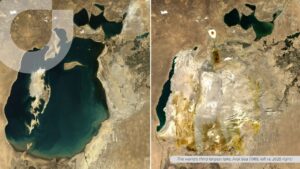
In a world defined by increasingly frequent and devastating climate disruptions, it is the silent, creeping crisis of drought that may prove most formidable. The challenge of water scarcity goes well beyond drought events, but droughts are a tangible concern for many citizens worldwide. Unlike hurricanes or floods that announce their arrival with fury, droughts operate insidiously: parching landscapes, eroding livelihoods, destabilizing economies, and endangering ecosystems without a single drop of rain falling out of place. As the OECD’s new Global Drought Outlook, launched last June 17th, underscores with clarity, the age of drought is not a distant hypothetical. It happens as I draft this article.
The report is a clarion call to all sectors of society, and especially to those of us in the business of water. It demands not only attention, but a fundamental shift: from reactive crisis management to proactive resilience-building. Given my long experience in engineering adaptive, forward-thinking water solutions across many continents, I view this moment as crucial. Our response to global drought risk will define not only our climate resilience but the moral and economic integrity of our societies.
The Cost of Inaction: Escalating Drought Impacts
Drought is no longer a localized agricultural inconvenience. It is a systemic, cross-sectoral stressor. According to the OECD, the area of land affected by drought has doubled since 1900. Today, 40% of Earth’s landmass experiences heightened drought frequency and intensity. As warming accelerates, the future threatens to multiply these extremes by up to sevenfold under a +4°C scenario.
The impacts are staggering. Drought now accounts for over one-third of disaster-related deaths despite representing just 6% of natural disasters. In 2021 alone, California incurred over $1 billion in agricultural losses. The Horn of Africa’s five-year rain failure left 23 million people in hunger. Hydropower outages, shipping disruptions through the Panama Canal, and surging food insecurity are no longer anomalies: they are actually harbingers of a new climatological regime.
The economic toll is equally sobering. The OECD estimates that the average cost of a drought event has more than doubled since 2000 and will rise at least 35% by 2035. This is not the price of nature; it is rather the cost of delayed action, fragmented governance, and underinvestment in resilience.
The Illusion of Water Abundance
As a CEO in the water sector, I have long been struck by a persistent paradox: water’s essential nature is matched only by our tendency to undervalue it, as I have often expressed. Today, irrigation consumes 70% of global water withdrawals, often inefficiently. Groundwater levels are declining in 62% of monitored aquifers, and urban soil sealing, an unintended consequence of unchecked development, chokes aquifer recharge across OECD countries.
Yet policy frameworks lag behind. The OECD notes that European water abstraction charges internalize merely 2–3% of water scarcity costs. Many nations still allocate water based on historical rights, ignoring the volatility of a changing climate. This disconnect between ecological reality and institutional inertia is untenable.
I believe that transparency and pricing reform are critical first steps. But more profoundly, I advocate for a new water ethos: one that prioritizes stewardship, integrates ecological flow needs, and repositions water not only as a critical input but as an infrastructure of resilience.
Resilience as Strategy – The Business Case for Drought Resilience
The most hopeful message in the Global Drought Outlook is not the inventory of risks; it is the catalogue of solutions. Resilience is within reach, but it requires more than engineering fixes, even if these are of paramount importance. It demands systemic thinking, cross-sectoral collaboration, and bold leadership.
The OECD lays out a framework that mirrors our own approach: understanding risk, reducing exposure, and empowering response capacity. Each domain requires investment; not only of financial capital but of creativity and ambition in how we shape solutions.
We must stop treating resilience as an externality. As the OECD notes, every dollar invested in drought prevention can yield up to ten dollars in long-term benefits. For companies, this translates into risk mitigation, supply chain stability, social license to operate, and long-term value creation.
But we cannot do this alone from the private sector. Governments must provide stable regulatory environments, align financial incentives, and support blended finance mechanisms that derisk early investments. Financial institutions must revise their exposure models to recognize water risk as material. And the international community must integrate drought into climate adaptation finance in a more systematic and just manner.
Equity, Ecosystems, and the Ethics of Adaptation
Finally, no drought strategy is complete without a reckoning with equity. The burdens of water stress fall most heavily on the poorest, the most marginalized, and the least responsible. Sub-Saharan Africa bears the heaviest drought mortality rates. Agricultural workers across Latin America and South Asia often lack access to basic adaptation tools.
A just transition in the water sector means not only investing in high-tech solutions for wealthy cities but ensuring access to safe, reliable water for vulnerable communities. It means recognizing the interdependence of human and ecosystem health: wetlands, forests, and riparian corridors are not luxuries but lifelines.
Time for a New Compact
The Global Drought Outlook is not just a report; it is a mirror. It reflects our collective fragility, but also our collective potential. As a business leader, I take its message as both a warning and a mandate.
Water resilience is the backbone of climate adaptation. It is the bedrock of food, energy, health, and geopolitical stability. And yet, we are treating it with the urgency of tomorrow when it demands action today.
The time has come for a new compact between the public and private sectors, between engineers and ecologists, between global North and South. Let us not squander the foresight this report provides. Let us meet drought not with despair, but with the ambition, intelligence, and resolve that our future demands.