Over the last month, Spain has lived through one of those meteorological episodes that feels like it rewrites the rules: successive storm systems, saturated soils, swollen rivers, and reservoirs rising by the day. For communities that have spent years under drought restrictions, or simply under the anxiety of diminishing buffers, this rainfall has been a real, immediate relief. But relief is not the same thing as resilience. And in water management, confusing the two is how countries sleepwalk into the next crisis.
From where I sit, as the CEO of a global company that designs and operates advanced water solutions, these weeks offer a useful lens: they show both how powerful “supply shocks” can be in the short run, now compounded by climate change, and how stubborn the structural drivers of scarcity remain in the long run. The most important lesson is not that it rained. It’s how it rained, where it rained, and what we had to do operationally because of that rain.
The rainfall was not just heavy: it was extraordinary in intensity, persistence, and concentration
Start with the baseline: January 2026 in peninsular Spain recorded an average precipitation of
119.3 mm, 185% of the 1991–2020 normal, classified by the Spanish Meteorological Agency (AEMET) as “very wet,” and among the wettest Januaries recorded since 1961 (and the second of the 21st century).
But the headline is not the national average; it’s the local extremes and the persistence. AEMET’s own station data shows January totals such as 411.2 mm in Ceuta, northern Africa (its highest since 2009), 399.1 mm in Vigo, and 385.6 mm in Pontevedra, both in NW Spain: a record there since the start of that series in 1986.
The pattern continued into February. In the week 11–17 February, AEMET reported accumulated rainfall at major observatories, including 166 mm in Vigo/Peinador, 137 mm in San Sebastián/Igeldo, 124 mm in Bilbao airport, and 118 mm in Pontevedra, all in northern Spain. And looking across the hydrological year, the national average accumulated precipitation from 1 October 2025 to 17 February 2026 reached 460 mm, about 42% above normal (323 mm).
That combination (very wet months plus repeated high weekly totals) matters because it changes the system’s behaviour. When soils are saturated, additional rainfall converts to surface runoff more quickly; rivers respond more sharply; reservoirs rise more quickly; and the operational priority can shift, within days, from “how do we save water for when it may be needed?” to “how do we keep people safe?”
The operational signals were as eloquent as the rainfall totals: record storage jumps, record releases
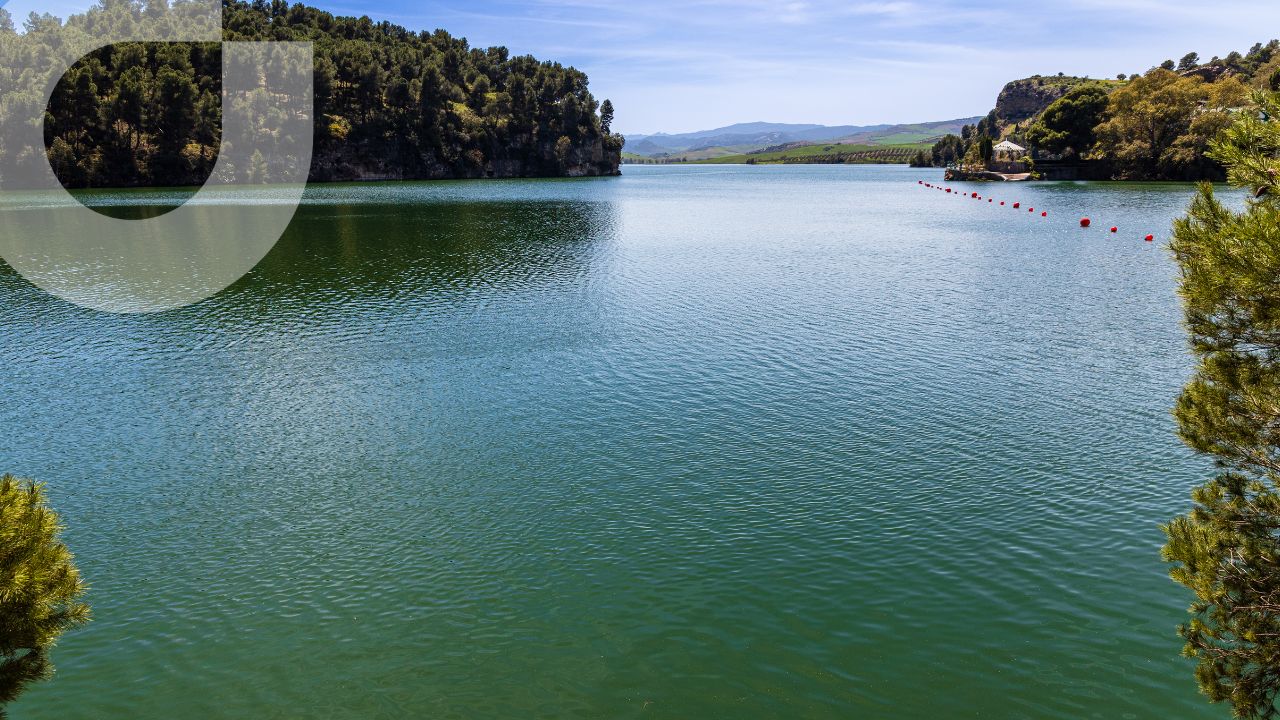
Spain’s reservoir system absorbed an enormous inflow pulse. MITECO’s weekly update for 10 February 2026 shows the national reservoir stock at 43,341 hm³ (77.3% capacity), after a weekly increase of 5,634 hm³, the largest weekly gain in decades of weekly reporting. A week later, MITECO reported 46,229 hm³ (82.5%), up another 2,888 hm³.
A legal text published in the official gazette (BOE) puts the magnitude in even starker terms: reservoir volumes increased by 4,517 hm³ between 26 January and 2 February (second largest weekly increase on record), then by 5,600 hm³ between 2 and 9 February (the historical record), totaling roughly 10,000 hm³ stored in two weeks.
And then there is the “hidden” side of full reservoirs: release management. The same BOE text notes that total controlled releases from reservoirs at red alert levels reached around 15,000 m³/s, described as an absolute record for inter-basin reservoir management; and that cross-border river flows toward Portugal reached 6,000 m³/s at Cedillo’s reservoir (in the Tagus, between Spain and Portugal), levels not seen since 1996.
These are not academic numbers. They are the operational signature of a country managing flood risk at scale, often while simultaneously being told (correctly) that it is structurally water-stressed.
At the basin and local scale, the same story repeats. In Madrid, authorities reported that on 10 February the average regulated flow reached nearly 400 m³/s (one of the largest values in their historical series), and that anticipatory controlled releases reduced downstream average flow to 205 m³/s; the Atazar reservoir alone was releasing 50 m³/s at the time of the statement. Canal de Isabel II, Madrid’s water utility company, detailed simultaneous releases from multiple dams (e.g., 30 m³/s from El Vado, 50 m³/s from Puentes Viejas, 25 m³/s from Pinilla), explicitly to preserve the freeboard required to safely absorb additional flood inflows.
In the Duero basin, the river basin authority described ramping releases from 4 m³/s up to a maximum of 135 m³/s, while noting that peak inflows were close to 280 m³/s, meaning the dam reduced the flood peak by more than half.
All of this reinforces a crucial point: when rainfall arrives in intense, repeated bursts, a significant share of that water is not available for later use. It must be routed, released, and managed for safety.
Why this rainfall relieves pressure now, but does not “solve” scarcity
So yes: reservoirs are up, restrictions may ease, and the buffer against a dry spring has improved. As of 17 February, Spain’s reservoirs were at 82.5%, with several northern and Atlantic-facing systems above 90%. This is real relief.
But scarcity is not just a snapshot of reservoir percentages. It’s a risk profile shaped by climate, hydrology, demand, and governance.
First, intensity and timing reduce “useful yield.” Flashier rainfall means more immediate runoff and flood peaks, and less infiltration into soils and aquifers, definitely once catchments are saturated. The legal text itself highlights that repeated episodes reduced soil absorption capacity and forced intensified hydraulic management, including controlled releases. In other words, the same rain that fills reservoirs can also bypass long-term storage pathways.
Second, geography still matters, and Spain’s water stress is not evenly distributed. Even in this wet moment, basin breakdown shows persistent asymmetry: the Segura, in SE Spain, remained at 45.6%, and the Júcar (eastern Spain) at 61.8%, while Atlantic and northern basins were far higher. A wet Spain is not the same thing as a water-secure southeast.
Third, a wet month does not cancel an arid trajectory. AEMET’s climate work emphasizes that Spain is expected to trend toward a more arid climate overall, even as extreme rainfall events become more frequent. This duality (lower average availability but sharper extremes) is exactly why “more rain” is not a strategy. The Mediterranean region, more broadly, is projected to experience declines in precipitation with warming.
Fourth, scarcity is increasingly a systems problem: infrastructure, finance, and governance. The most unforgiving arithmetic in water is not rainfall; it’s losses, underinvestment, and weak incentives. Spain’s infrastructure operators and sector leaders estimate the country needs on the order of €4 billion per year for a decade to renew networks and modernize treatment. They point to renewal rates of 0.54% annually for water supply networks and 0.12% for sanitation (versus ~2% recommended), and to 19–20% non-revenue water in networks on average, losses a water-stressed country cannot afford.
When governance and finance lag, heavy rainfall can even mask the problem: full reservoirs create political complacency just when investment and reform are most feasible.
And this is not uniquely Spanish. Northern Africa has experienced a parallel paradox: Morocco’s recent storms forced the evacuation of more than 100,000 people, while the same rains raised national reservoir levels to around 60% after they had been near 25% a year earlier, ending a drought of more than seven years. Flood relief does not eliminate structural vulnerability, especially when rapid urbanization, limited drainage infrastructure, and constrained public finances amplify risk.
Moving from relief to resilience: what should change now, while reservoirs are high
The right time to fix structural water scarcity is not during an emergency; it’s immediately after one, when the system has breathing room, and the public can see, in real time, what extremes look like.
Three priorities stand out, to my understanding:
- Upgrade “capture and control” for a world of extremes. That means modern flood-aware reservoir operations (forecast-informed releases, digital twins, real-time basin monitoring), as well as nature-based and hybrid storage: stormwater retention, restored floodplains, and managed aquifer recharge that turns short, intense rainfall into groundwater buffers.
- Treat financing as a core part of water security, not a footnote. Europe’s own policy logic (including cost-recovery principles under the Water Framework Directive) recognizes that tariffs, transfers, and private finance all play roles. Yet, implementation is politically and technically difficult. We need transparent investment pipelines, clearer rules for blended finance, and pricing structures that protect vulnerable households while still funding maintenance and renewal.
- Make governance match hydrology. Scarcity is managed through institutions: basin planning, groundwater enforcement, drought triggers, allocation rules, data transparency, and cross-sector coordination (agriculture, cities, energy, ecosystems). The more variable the rainfall becomes, the more damaging fragmented decision- making will be.
Spain’s recent rains are a gift. They refill reservoirs, soften the near-term outlook, and buy time. But they are also a warning: our climate is becoming more volatile, our infrastructure is aging, and our financial and governance models are not yet aligned with the new reality.
A deluge is not a strategy. Strategy is what we do next, while the reservoirs are still high.