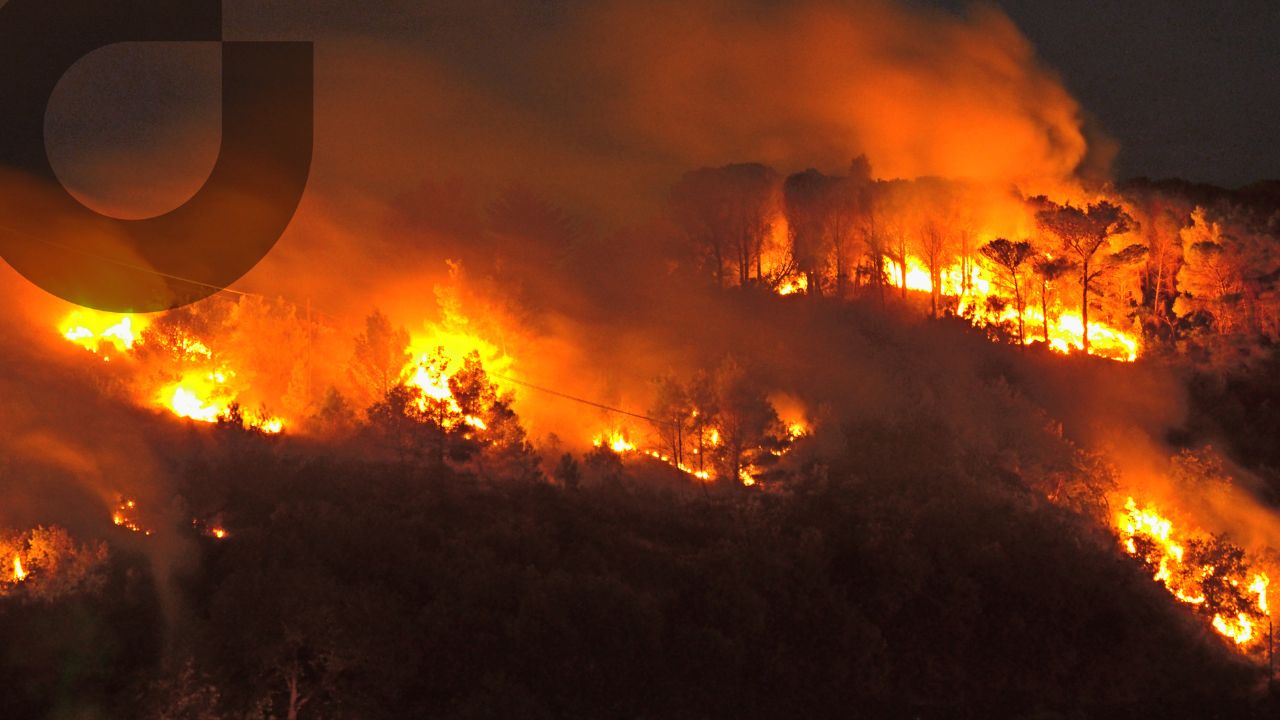
Every summer, flames return with growing ferocity. Rising temperatures, prolonged droughts, and poor land management have turned large parts of the planet into tinderboxes. From the pine forests of southern Europe to the chaparral of California, the bushlands of Australia, and Canada’s boreal zones, wildfires are multiplying in intensity, speed, frequency, and cost.
The 2025 wildfire season is already a stark warning. Across Spain — from Castilla y León, Galicia, and Extremadura to Madrid, Valencia, and Zamora-León — thousands have been evacuated and over 375,000 hectares have burned, with fires in Ourense and Jarilla among the most devastating on record. On Rhodes in Greece, more than 19,000 people fled advancing fire fronts. In California, decades of population growth in wildland-urban interfaces have created sprawling areas where fire risk is constant and firefighting costs exceed several billion dollars annually. And in Canada, millions of acres of forest, including carbon-rich peatlands, have burned this year, releasing unprecedented greenhouse gas emissions
The pattern is global, the causes are interlinked: hotter summers, longer droughts, weakened ecosystems, and — at the core — the absence or mismanagement of water. Not just for extinguishing flames, but as a critical element of prevention.
Prevention as Strategy, Not Reaction
Around the world, pioneering initiatives are proving that fire risk can be reduced if we plan ahead and place water at the heart of prevention.
In Spain, the Guardian system in Valencia deploys a network of towers that spray recycled water, creating “wet corridors” to slow or stop advancing flames before they reach towns. In Galicia, strategically placed rural reservoirs and traditional grazing practices by wild horses and goats help clear combustible undergrowth naturally.
In California, Fire Safe Councils bring together communities, landowners, and authorities to reduce fuel loads, create defensible space, and secure water access points before fire season begins. In Australia, Indigenous fire management practices, low-intensity, controlled burns in cooler months, are reducing fuel build-up while maintaining ecosystem balance. And in Indonesia, the Fire Free Alliance partners with villages to end slash-and-burn agriculture, funding water storage and irrigation alternatives to make fire-free farming viable.
But what’s often overlooked is that while we discuss solutions, large portions of forestland — particularly in countries like Spain — remain unmanaged. Only 11% of Spain’s forested land has a forest management plan in place. This neglect has helped turn our forests into ticking time bombs. Paradoxically, the denser our forests become, the more vulnerable they are: Spain’s forests are now denser than at any point in the last 100,000 years. Without proactive forest management, we are stacking fuel for the next catastrophe.
Countries like Germany, with half the forest area of Spain, produce three times more wood through active, sustainable forestry. Sweden, the only European country with more forest area than Spain, has built an enviable bioeconomy: urban districts constructed from wood, and global companies like IKEA driving demand for sustainable timber. Meanwhile, forest-related employment in Spain has dropped 47% in the last decade, the highest decline in Europe, showing the social and economic consequences of inaction.
The Role of Water in Fire Resilience
Water is typically seen as the tool for fighting fires once they have begun. But its greatest leverage lies in its use before ignition: keeping soils and vegetation hydrated, ensuring rapid access for firefighting teams, and designing landscapes that incorporate natural and artificial firebreaks sustained by water.
Dry vegetation ignites faster, burns hotter, and spreads further. By contrast, moisture-rich landscapes buy precious time for containment and time is everything when facing a fast-moving wildfire. Water resilience begins long before the first spark. Maintaining vegetation and soils with adequate moisture levels, even during peak drought conditions, can drastically reduce the speed and intensity of a fire. In regions like California, the use of recycled water to irrigate high-risk buffer zones has kept them green through record heatwaves, creating living barriers that slow fire spread without competing with potable water supplies. Similarly, in Spain and Portugal, strategically placed irrigation systems and water-retaining firebreaks act as both physical and hydrological obstacles, forcing fires to lose momentum.
Access is equally critical. Rural reservoirs, underground storage tanks, and heli-hydrants positioned along known fire corridors can cut firefighting response times from hours to minutes. This infrastructure, when integrated with natural water systems such as wetlands, rivers, and riparian forests, creates a multi-layered defense. These hydrated landscapes not only resist ignition but also provide safe zones for wildlife and communities. In essence, by embedding water management into land use and emergency planning, we transform water from a reactive tool into a proactive shield — one that can mean the difference between a contained fire and a national disaster.
But water alone is not enough. The return on investment from sustainable forest management is rapid and undeniable, environmentally, socially, and economically. Yet forestry remains underfunded and misunderstood. While Europe allocates nearly 50% of its agricultural budget to livestock feed production, much of it on monoculture fields with little to no biodiversity, forest management continues to be treated as a cost, not a strategic pillar. And paradoxically, failing infrastructure projects like highways, airports, or rail stations receive continuous public subsidies under the banner of ‘state responsibility,’ while forests are left to burn.
Solutions that Work and Can Scale
Effective, water-centered fire prevention combines technology, infrastructure, and governance:
- Strategic reservoirs in rural and peri-urban high-risk zones to reduce response times.
- Recycled water networks for maintaining vegetation moisture in vulnerable corridors.
- Heli-hydrants — large open-top tanks for rapid helicopter refills — strategically placed along fire-prone ridges.
- Wetland and riparian restoration to act as natural firebreaks while supporting biodiversity.
- Automated sprinkler barriers — perimeter spraying systems that activate when fire risk is extreme.
- Regulatory incentives and penalties linking water access and landowner responsibilities — including fines for neglect, subsidies for compliance, and state support for landowners to keep fields cleared and vegetation properly managed.
These are not theoretical solutions. They are already being implemented, but too often in isolated pilot projects rather than as part of a coordinated, long-term fire prevention strategy. To make fire prevention truly scalable, it must be embedded not only in land management policy but also in national and regional budgets. Public funding must shift from reactive firefighting to proactive infrastructure, ensuring that water resilience is treated as a strategic investment, not a discretionary expense.
Scaling these models requires political will, cross-sector coordination, and a recognition that water resilience is fire resilience. What’s needed now is not invention, but implementation.
From Risk to Resilience
The lesson from Spain to California, from Rhodes to the Australian outback, is clear: water management is fire management. Without strategic water planning, storage, distribution, and governance, the cost of suppression will continue to rise, and the toll on communities, ecosystems, and economies will deepen.
And without forest management, our fire strategy is incomplete. Reforestation without active stewardship is not a solution, it’s a slow-moving disaster. Forest thinning, sustainable timber production, and active landowner engagement must be seen as tools of climate resilience. Harvesting wood, when done responsibly, is not the enemy, it should be a moral and environmental obligation.
In the age of climate change, fire prevention must evolve from an afterthought to a central pillar of environmental and urban planning. We must rethink not just how we fight fires, but how we prepare for them, year-round, across entire landscapes, with water as the defining factor.
Because when the heat rises and the winds shift, one truth holds everywhere: No Water, No Nothing.