Some disasters can be analyzed from a distance, through numbers, probabilities, and economic losses. And there are others for which that distance is much harder to maintain.
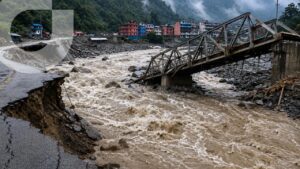
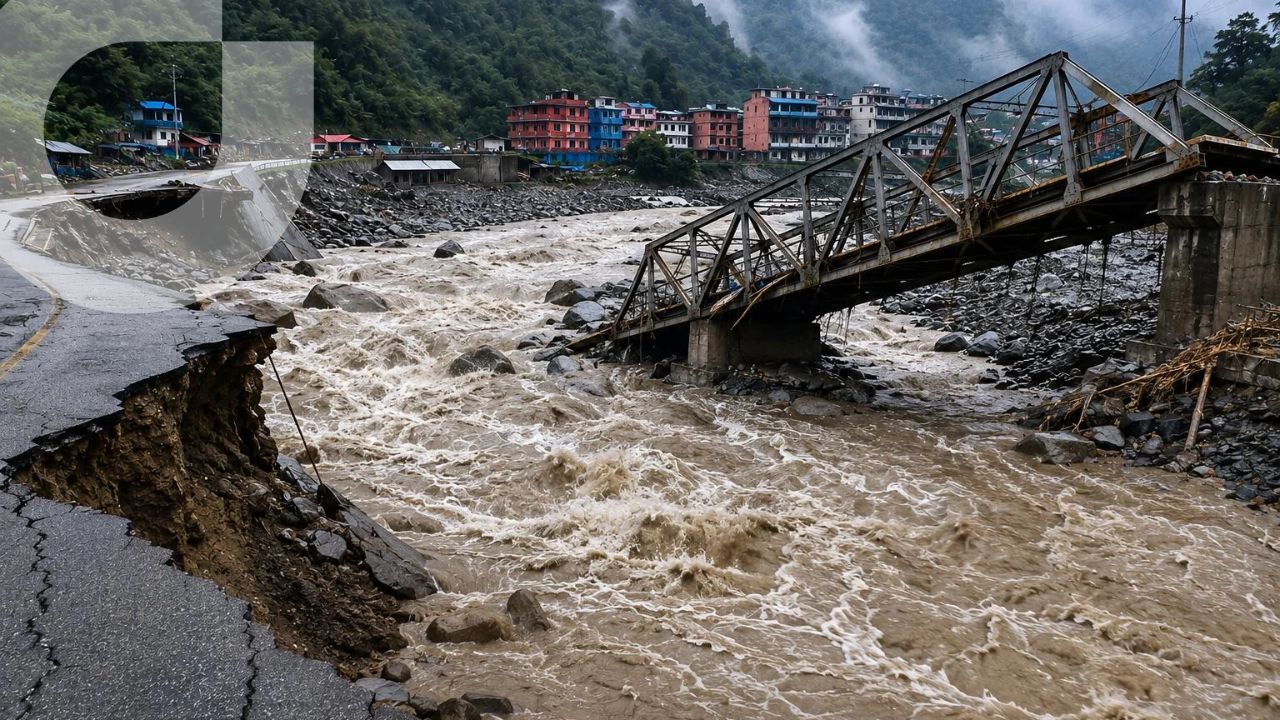
For me, the catastrophic flood that struck the Nepal-China border on August 26 belongs to the latter. My wife has worked for years in Nepal with an NGO. Through her, Nepal has become more than a country I know through projects, statistics, or maps. It is therefore difficult to look at images of devastated communities along the Bhote Koshi-Trishuli corridor and see only another data point in the accelerating economics of climate risk.
The human numbers alone make that impossible. As Nepal formally ended active search-and-rescue operations on October 5, at least 1,455 people had been confirmed dead, and 5,285 remained missing. Some 13,795 people had been rescued.
But this disaster also demands analysis, precisely because what happened in Nepal may tell us something important about the changing nature of water risk.
This was not, strictly speaking, a conventional flood. Preliminary scientific assessments indicate that a massive slope failure near Langtang Lirung triggered an ice-rock avalanche, which then generated a cascading flow of rock, ice, meltwater, sediment and debris through the Lhende Khola and into the Bhote Koshi-Trishuli river system. The Financial Times, drawing on scientific estimates, reported that between 50 million and 100 million cubic meters of material may have fallen—an event of extraordinary magnitude.
The distinction matters. Our traditional water infrastructure was largely designed around statistical assumptions about rainfall, river discharge and historical flood recurrence. Climate change is increasingly challenging those assumptions. In mountain regions, water risk can now originate not only in the atmosphere or the river basin, but in the destabilization of the cryosphere itself.
Some time ago, I wrote an article for No Water No Nothing about the consequences of glacier retreat. My concern was that we continue to treat disappearing glaciers as a distant environmental indicator when they are, in reality, strategic water infrastructure created by nature over millennia.
Unfortunately, the Nepal disaster demonstrates the other side of that argument. A destabilized cryosphere creates risks not only from having too little water in the future, but from having catastrophically too much water, ice, and sediment in the wrong place, at extraordinary velocity, today.
The underlying trend is increasingly difficult to ignore. ICIMOD estimates that glaciers across the Hindu Kush Himalaya lost around 12% of their area and 9% of their ice reserves between 1990 and 2020. More troublingly, the rate of ice loss has approximately doubled since 2000. Nearly two billion people ultimately depend on water originating in these “water towers of Asia.”
That converts glacier retreat from an environmental externality into an economic variable.
And the economic anatomy of the Nepal disaster is revealing. The government’s Rapid Damage and Needs Assessment estimates approximately $1.81 billion in physical damage and another $883 million in economic losses: roughly $2.7 billion in total effects. Recovery and reconstruction requirements are estimated at approximately $4.78 billion.
For a relatively small economy, this is an enormous balance-sheet shock.
Infrastructure absorbed much of it. Around 70 kilometers of roads and 80 bridges were damaged, more than 150 kilometers of telecommunications fiber were affected, and 13 hydropower projects suffered damage. Hydropower is particularly important because Nepal has spent years turning its extraordinary water resources into an economic asset, including through electricity exports.
The flood also illustrates how water risk propagates through systems that initially appear unrelated to water.
The Rasuwa and Tatopani crossings together accounted for around 22% of Nepal’s imports from China in fiscal 2025-26, while Rasuwa handled nearly half of Nepal’s exports to China. Damage to this corridor therefore transmits the shock from mountain hydrology into logistics, wholesale trade, manufacturing, construction and employment. The International Labour Organization estimates that approximately 21,400 employed people lived within four kilometers of the flood footprint, with tourism, agriculture, transportation and small businesses particularly exposed.
This is what climate risk increasingly looks like economically: not a discrete environmental event but a cascading infrastructure shock.
And that changes the investment question.
The temptation after a catastrophe is understandably to focus on reconstruction. Nepal clearly needs it. The World Bank has already made up to $170 million of emergency financing available. But rebuilding what existed before cannot be the objective if the underlying probability distribution has changed.
Adaptation has to become an infrastructure category in its own right.
Nepal’s National Adaptation Plan estimates investment requirements of $47.4 billion through 2050, of which the country expects to finance only $1.5 billion domestically. Disaster risk reduction alone accounts for approximately $8.05 billion; water resources and energy require another $5.35 billion.
Those numbers might once have seemed aspirational. After August 26, compare them with a single disaster that will require almost $4.8 billion in recovery and reconstruction.
The economics of prevention suddenly look rather different.
Nepal has now announced a $50 million program to reduce risks at four dangerous high-altitude glacial lakes, combining controlled drainage with sensors, forecasting, early-warning systems and community resilience. These are precisely the types of investments that need to be scaled: satellite and ground monitoring, hydrometeorological networks, automated warning systems, resilient bridges and roads, better watershed management, sediment control, redundancy in critical infrastructure and engineering standards explicitly designed for cascading hazards.
There is also an unavoidable transboundary dimension. Water does not recognize national borders; neither do glaciers, debris flows or flood waves. Monitoring and managing Himalayan risk therefore requires data sharing and institutional cooperation across borders, particularly where an event originating in one jurisdiction can devastate communities and infrastructure in another.
This is not primarily an argument about who should be blamed for a particular disaster. It is an argument about how we price and manage a new class of risk.
For companies working in water, infrastructure and environmental solutions, there is an additional responsibility. We often speak about resilience as an investment opportunity. It is one. Billions of dollars will have to be deployed globally in monitoring, storage, protection, reuse, watershed restoration, flood management, and resilient infrastructure.
But Nepal reminds us what lies behind that investment thesis.
Adaptation capital is not merely another infrastructure asset class. It represents schools that remain accessible, power plants that continue operating, roads that keep economies connected, and communities that receive enough warning to move out of harm’s way.
When I wrote about glaciers for No Water No Nothing, I argued that their disappearance would ultimately reshape economies because water underpins virtually everything else.
After Nepal, I would add a second proposition: the transition is itself dangerous.
We are moving from a relatively stable hydrological world toward one characterized by greater volatility, nonlinear events, and cascading risks. Managing that transition will require science, technology, international cooperation and, above all, capital deployed before disasters rather than overwhelmingly after them.
For Nepal, that distinction is no longer theoretical.
And for those of us with personal ties to the country, the consequences are, too.